
How much does a GCSE Computer Science tutor cost? (2026 UK Price Guide)
If your child is taking GCSE Computer Science, you have probably already noticed how quickly the subject diverges from other GCSEs. In History or Science, revision revolves around memorising facts and practicing essays. In Computer Science, half the qualification requires writing working Python code under exam conditions, tracing algorithms with pen and paper, and understanding binary logic down to the transistor level.
When a student falls behind, parents instinctively look for private tutoring. But what does a GCSE Computer Science tutor actually cost in the UK in 2026, what are you paying for, and is an expensive tutor always the best solution?
Here is an honest breakdown of UK hourly rates, the hidden annual costs, and how to get maximum return on your investment before spending thousands of pounds.
Average GCSE Computer Science tutor rates across the UK (2026)
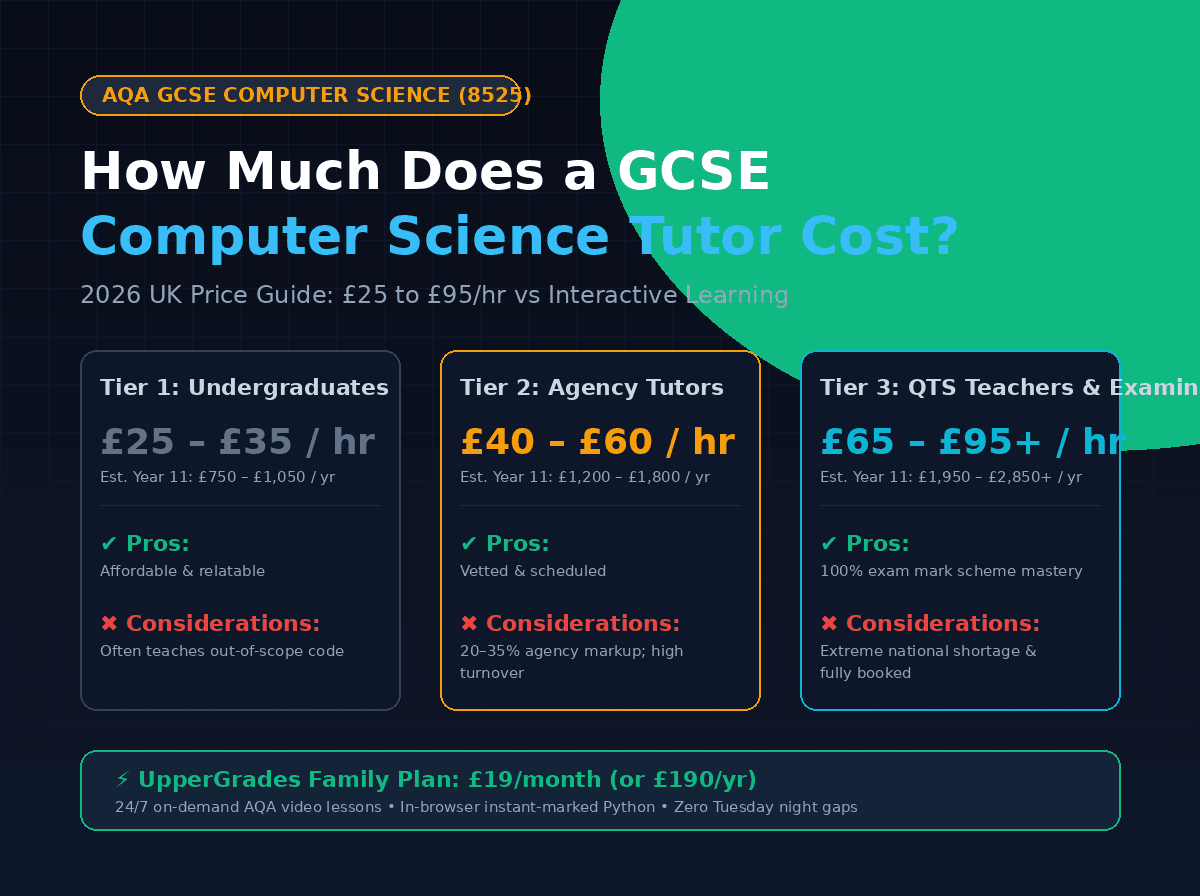
Across the UK, private GCSE Computer Science tuition currently ranges from £25 to £95 per hour. Where a tutor falls within this spectrum depends on location, agency commissions, and their professional teaching credentials:
- Undergraduate students & computer science graduates: £25 to £35 per hour
- Experienced freelance tutors & online agencies (MyTutor, Tutorful, First Tutors): £40 to £60 per hour
- Qualified UK classroom teachers (QTS) & current examiners: £65 to £95+ per hour
- London & South East in-person home tutoring: £60 to £100+ per hour
While these hourly numbers sound manageable in isolation, private tuition is rarely a one-off expense. To see meaningful grade improvement, tutors almost universally recommend weekly sessions throughout Year 10 and Year 11.
The true annual cost: calculating the full investment
If your child starts private tuition in September of Year 11 and continues until their May examinations, you are typically paying for 30 weeks of instruction:
- At £35/hour (university student): £1,050 per year
- At £50/hour (agency tutor): £1,500 per year
- At £75/hour (qualified teacher / examiner): £2,250 per year
If tutoring starts earlier in Year 10, the total investment easily exceeds £3,000 to £4,500 for a single GCSE subject. For families with multiple children, or students who also require tutoring in Maths or Sciences, private 1-to-1 tutoring can quickly become one of the largest household expenses of the academic year.
The three tiers of tutors: who are you actually paying for?
Understanding why rates vary so wildly helps parents avoid common, expensive mistakes.
Tier 1: University students & recent graduates (£25–£35/hour): Enthusiastic and relatable, but coding in a university lecture hall is completely detached from the secondary school curriculum. University students often don't know the exact syllabus constraints of AQA 8525, frequently teaching shortcuts (like Python list comprehensions, ternary operators, or .sort() functions) that score zero marks on GCSE mark schemes.
Tier 2: Experienced tutors via online agencies (£40–£60/hour): Platforms provide vetted tutors and recorded classrooms, but take between 20% and 35% commission on every lesson. Furthermore, few agency tutors specialize solely in AQA Computer Science; many teach Maths, Physics, and Coding across multiple exam boards interchangeably.
Tier 3: Qualified classroom teachers & examiners (£65–£95+/hour): They know every mark-scheme trap and precisely what examiners look for on 6-mark questions. However, with the national shortage of computing teachers, they are heavily oversubscribed and command premium rates.
The "Tuesday night problem": why weekly tutoring often falls short
Even with a top-tier tutor, private tuition has an inherent structural flaw in Computer Science: the 167-hour gap. Writing code is a practical, muscle-memory skill like playing an instrument. If a student meets a tutor on Saturday morning for one hour, they have 167 hours of the week where they are completely on their own.
When they get stuck on an `IndexError` while writing Python homework on Tuesday night, they cannot ask their tutor without booking another expensive session. Half of the following weekend's session is then spent untangling homework bugs rather than mastering new exam topics.
Paper 1 vs Paper 2: where private tutoring helps and where it doesn't
AQA GCSE Computer Science is split into two distinct 50% papers. Private tutoring can be effective for Paper 1 (algorithm design and tracing). But paying £50 an hour for a tutor to recite CPU registers, the fetch-decode-execute cycle, or network protocols for Paper 2 is an extraordinarily expensive way to learn theoretical revision content.
Modern alternatives: 1-to-1 tutoring vs interactive mastery
Before committing to £1,500+ a year for a private tutor, parents should consider modern, interactive alternatives that address the weaknesses of weekly tuition. At UpperGrades, short 5- to 12-minute video lessons pause at checkpoints to ask examinable questions. If a student answers incorrectly, the video automatically rewinds to the exact sentence explaining the concept.
Students practice writing real Python directly in their browser, with test cases marked immediately so they never get stuck alone on a Tuesday night. And at £19/month (or £190/year), one family plan covers all children in the household.
How to test your child's baseline before hiring a tutor
If you suspect your child is struggling, do not rush into signing a long-term tutoring contract. Start with these free diagnostic steps:
- Check their binary and logic foundation with our Free Binary & Hex Assessment (no account or payment required).
- Download our printable AQA GCSE Computer Science Revision Checklist to identify specific red-flag topics.
- Try our interactive Two's Complement Calculator and File Size Calculator to see step-by-step exam working.
For the vast majority of students, having 24/7 access to specification-accurate video lessons and instant-feedback coding practice delivers higher grades at a fraction of the cost.