
Online vs in-person GCSE Computer Science tutors: which gets higher grades?
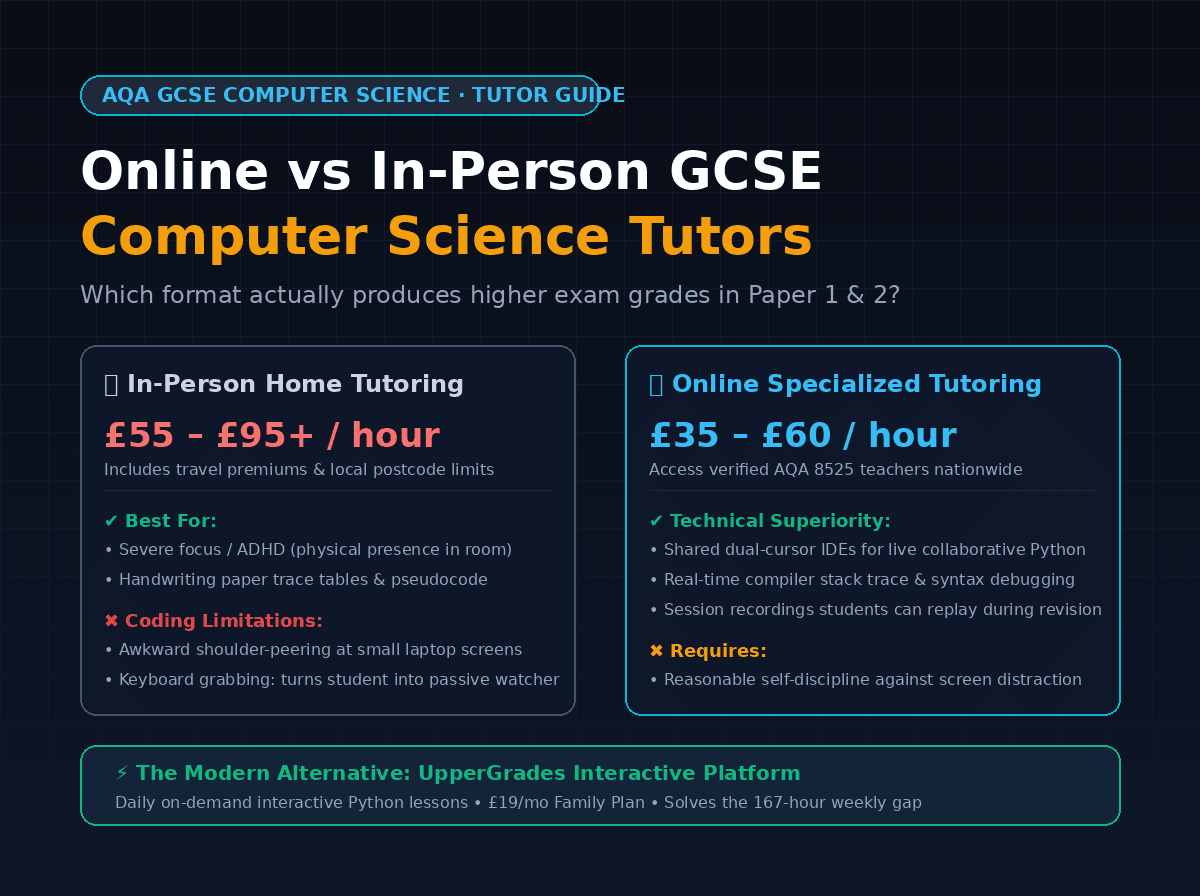
When parents begin searching for a GCSE tutor, their natural instinct is almost always to look for someone who can sit at the kitchen table.
For subjects like English Literature or primary Maths, having an experienced teacher sitting beside your child with a textbook and a pen works wonders. It commands attention, eliminates phone distractions, and builds rapport.
In GCSE Computer Science, however, this traditional instinct frequently backfires. Half the qualification involves typing, executing, and debugging real Python code on a screen. Because of this, what feels like 'premium' in-person tuition can often turn into an awkward, inefficient, and expensive compromise.
The mechanical reality: why coding at a kitchen table is awkward
Picture how an in-person Computer Science lesson unfolds in your home: your child sits in front of a laptop, and the tutor leans over their shoulder at an angle, trying to read 14-point Python code on a 13-inch screen.
When the student encounters a syntax error or indentation bug, the tutor either reaches awkwardly across the student to point at the screen, or asks to take over the keyboard. Once the adult is typing, the student slips into passive watching mode, and active problem-solving evaporates.
The online advantage: collaborative coding and dual cursors
Contrary to the belief that online learning is impersonal, Computer Science is the one subject where a digital environment is demonstrably superior to physical proximity:
- Dual-cursor shared IDEs: Platforms like Replit, VS Code Live Share, or browser-based sandboxes let both tutor and student type in the same file simultaneously.
- Instant terminal output: When code throws an exception, both parties see the exact stack trace in real time without squinting at a single laptop.
- Session recordings for revision: A 60-minute online session can be recorded so a student can re-watch tricky algorithm explanations before exams.
The geography problem: accessing genuine AQA specialists
The single biggest factor in GCSE Computer Science tutoring success is whether the tutor understands the exact, idiosyncratic requirements of the student's exam board. On AQA 8525, examiners penalise students for using Python helper functions like .sort() or .index() on algorithm questions, and test a specific pseudocode dialect.
If you limit your search to tutors who can physically drive to your house, you are restricted to whoever lives within a 5-mile radius—often undergraduate students or generalists. Going online removes the postcode lottery, allowing you to hire verified AQA examiners and teachers regardless of where you live in the UK.
The price gap: travel fees vs actual teaching
In-person tutors charge for travel time and mileage, pushing rates to £55 to £95+ per hour (especially in London and the South East). Online 1-to-1 tutoring typically costs £35 to £60 per hour. Over a 30-week Year 11 academic cycle, choosing an in-person tutor adds £600 to £1,000 in travel premiums for the exact same syllabus content.
When is in-person tuition genuinely the better choice?
In-person tutoring is the right decision if your child has severe focus challenges (such as ADHD) where the physical presence of an adult in the room is needed to prevent multi-tab distraction, or if the tutor focuses specifically on paper-based trace tables and handwritten exam technique.
The UpperGrades approach: on-demand interactive mastery
Whether online or in-person, weekly tutoring leaves a 167-hour gap between sessions. At UpperGrades, short 5- to 12-minute video lessons pause at checkpoints to verify understanding, while students practice writing real Python directly in their browser with automated test cases.
At £19/month (or £190/year), one family subscription covers all children in the household with unlimited 24/7 access, offering an affordable foundation that replaces or drastically reduces the need for expensive private tutoring.
- Check their binary and logic foundation with our Free Binary & Hex Assessment.
- Identify weak points on our printable AQA GCSE Computer Science Revision Checklist.
- Explore our interactive tools: Hexadecimal & Nibble Converter and Binary Shifts Calculator.