
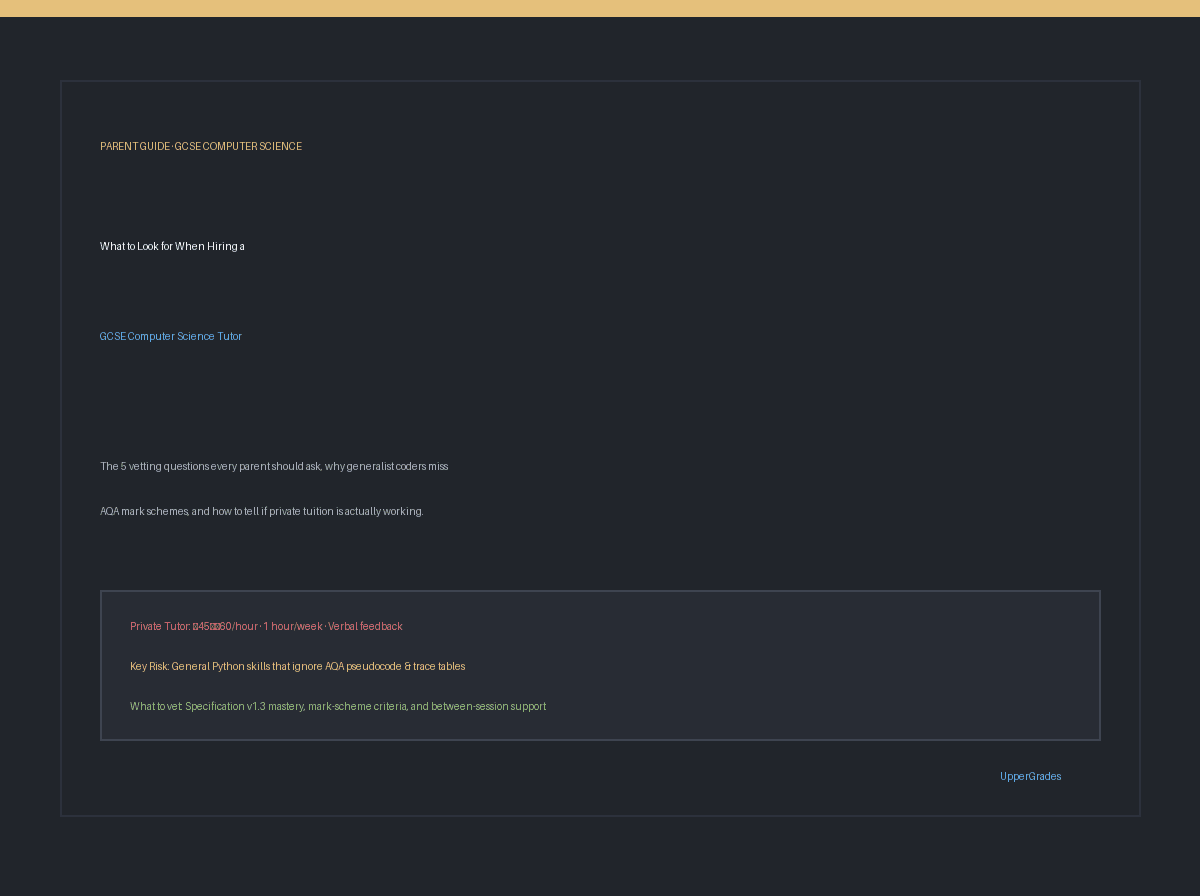
What to look for when hiring a GCSE Computer Science tutor
If your child is finding GCSE Computer Science challenging, hiring a private tutor is often the first thought that comes to mind. It feels reassuring: one hour a week with an expert who can explain things patiently.
In Maths or English, most experienced tutors know the national curriculum inside out. But Computer Science has a unique trap for parents: almost anyone who writes code for a living, or studies computing at university, can advertise themselves as a GCSE tutor.
Writing commercial software and guiding a teenager through the AQA 8525 mark scheme are two completely different skills. Here is what parents need to know before spending £45 to £60 an hour, and the five vetting questions that will tell you if a tutor is genuinely equipped for the exam.
The "Generalist Coder" trap: why industry coders often lose students marks
The biggest misconception in GCSE Computer Science is that someone who is good at coding will automatically be good at teaching the GCSE.
In the tech industry, good programmers write short, efficient code by using built-in language shortcuts and libraries. If a professional needs to sort a list of names in Python, they write names.sort().
In an AQA 8525 Paper 1 exam, writing names.sort() will score zero on an algorithm design question.
Why? Because the exam is testing whether your child understands the mechanics of algorithmic thinking — how to compare adjacent items, swap them, and loop through passes using a bubble sort or divide-and-conquer using a merge sort. A tutor who does not live and breathe the AQA mark scheme will often teach your child Python shortcuts that are great for real-world projects, but devastating in an exam hall.
Similarly, AQA uses a specific dialect of pseudocode with explicit keywords (like RECORD ... ENDRECORD and SUBROUTINE ... ENDSUBROUTINE) that differs substantially from other exam boards like OCR or Edexcel. If your tutor teaches generic pseudocode, your child will lose marks on syntax questions.
5 vetting questions every parent should ask
Before committing to weekly sessions, ask any prospective tutor these five questions:
- 1. Which specific exam board and specification version do you teach? There is no such thing as a "generic" GCSE Computer Science qualification. AQA (8525), OCR (J277), and Edexcel (1CP2) have completely different papers, coding requirements, and theory weightings. Furthermore, AQA released an updated version (version 1.3) with significant syllabus changes: network topologies (star and bus) and protocols like UDP and FTP were dropped entirely. A tutor who doesn't instantly know which specification version your child's school is sitting will waste valuable revision time teaching outdated material.
- 2. How do you teach Paper 1 algorithm questions? Listen carefully to how they answer. If they only mention writing Python in a code editor, be cautious. Half of Paper 1 is theoretical problem-solving: completing trace tables, determining the purpose of unfamiliar algorithms, and writing algorithms using standard constructs (sequence, selection, and iteration). A strong tutor will emphasize pen-and-paper tracing alongside practical programming.
- 3. How do you check that my child genuinely understands? In a 1-to-1 session with an adult, teenagers are notorious for "polite nodding". When an adult asks, *"Does that make sense?"*, almost every student smiles and says yes to avoid feeling embarrassed — even if they are completely lost. Ask the tutor how they assess understanding. Do they ask open-ended prediction questions (*"Before we run this, what will line 4 print?"*), or do they do the typing while your child watches? Active recall is the only way coding concepts stick.
- 4. What happens when my child gets stuck on homework on a Tuesday? Private tutoring provides one hour of instruction per week. That leaves 167 hours where your child is working on their own. When they get stuck on a programming assignment three days after a tutoring session, can they get help, or do they have to wait another five days? Gaps that go unaddressed between sessions quickly compound into frustration.
- 5. What visibility will I have as a parent? After an hour-long session, most parents receive brief verbal reassurance at the front door (*"He did great today, we worked on loops"*). While well-meaning, that doesn't tell you whether your child has mastered count-controlled loops versus condition-controlled loops, or if they understand zero-based array indexing. Ask if the tutor provides written diagnostics tracking which specific specification points are secure.
The real cost: what does private tutoring add up to?
Private GCSE Computer Science tutors in the UK typically charge between £45 and £60 per hour.
Over a standard 36-week academic school year, that represents an investment of £1,620 to £2,160 per child. If you have two children revising GCSEs, that cost doubles.
You can run your own household numbers with our interactive GCSE tutor cost calculator, which compares traditional hourly rates against the UpperGrades £19/month family plan.
When does a private tutor make sense?
To be fair to the tutoring profession, there are situations where a dedicated 1-to-1 human tutor is worth every penny:
- Specific emotional blocks: If a student has developed deep exam anxiety and needs personalized, gentle encouragement to regain confidence.
- Targeted mock debriefs: A one-off session with an experienced examiner to go through a marked mock paper line by line to understand where method marks were awarded.
- Independent non-school candidates: Students who are home-schooled and require a specialist teacher to oversee their coursework and syllabus schedule.
The alternative: why continuous adaptive practice works better
For the majority of Year 10 and Year 11 students, what is missing isn't intelligence — it is immediate feedback at the point of misunderstanding.
When a student watches a video or reads a revision guide, they learn passively. UpperGrades was designed to combine the diagnostic precision of an expert AQA teacher with the accessibility of a 24/7 online platform:
- In-video checkpoints: Lessons pause every few minutes to ask an examinable question. If your child gets it wrong, the video automatically rewinds to the exact moment that re-explains it.
- In-browser Python and SQL execution: No messy IDE setup or screen-sharing headaches. Real code runs directly in the browser with instant test-case marking.
- 100% AQA 8525 alignment: Every question, trace table, and coding challenge is written strictly to AQA mark-scheme standards.
- Live parent dashboard: You see completed modules, checkpoint scores, and mastery percentages across your entire household on one £19/month family plan.
Free revision resources to get started today
Whether you decide to hire a tutor or explore platform learning, you can access these free revision resources on UpperGrades with no account required:
- AQA GCSE Computer Science revision checklist: The complete 8525 specification as an "I can..." tick-off list.
- AQA GCSE Computer Science grade boundaries: Official boundaries from 2022 to 2025 with mock exam score classification.
- AQA GCSE Computer Science tutor comparison: A detailed feature-by-feature comparison and interactive cost calculator.
Sources
- AQA, GCSE Computer Science (8525) Specification
- The Tutors' Association, UK Private Tuition Industry Benchmarks and Standards